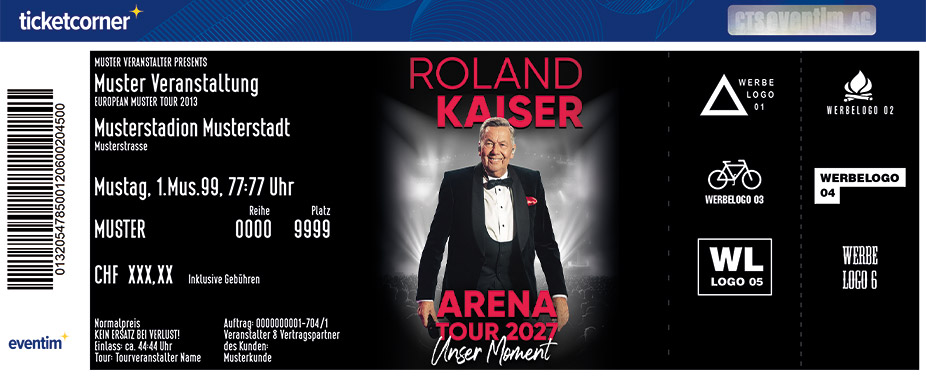
Roland Kaiser had his breakthrough in 1980 with the song "Santa Maria". To date, he has sold more than 90 million records, making him one of Germany's most successful pop singers. In addition to his own songs, he has also written lyrics for well-known artists such as Peter Maffay and Karat.
Born in 1952, Roland Kaiser grew up with his adoptive mother in war-torn West Berlin. At the age of 15, he dropped out of school and began an apprenticeship as a merchant. After further training as a car salesman, he manages the advertising department of a Berlin car dealership as a young adult.
First successes as a musician
In the 1970s, Roland Kaiser begins to perform in West Berlin bars and at weddings in the evenings. This brought him to the attention of music producers Gerhard Kämpfe and Thomas Meisel. Kaiser's first single, "Was ist wohl aus ihr geworden?" was released in 1974. - However, the record was not very successful.
His 1976 single "Frei, das heißt allein", a version of Ricky King's instrumental "Verde" with German lyrics, was more popular. The song reached number 14 in the German singles charts.
One year later, Roland Kaiser had another success with the single "Sieben Fässer Wein", a cover version of a traditional Caribbean song. With this track, which makes it to number 7 in the singles charts, he achieves his breakthrough as an up-and-coming artist.
"Santa Maria": Roland Kaiser's most successful single
In May 1980, Roland Kaiser releases his most successful single to date, "Santa Maria". The melody comes from a track by the Italian band "Oliver Onions". Kaiser writes the lyrics together with the lyricist Norbert Hammerschmidt. "Santa Maria" reaches number one in Germany, the Netherlands and Belgium and is awarded gold.
Music career despite COPD
In the 1990s, Roland Kaiser releases more successful singles and albums that reach the Top 100 in Germany. Between 1995 and 2001, his song "Alles, was du willst" becomes the theme song of the doctor series "Doktor Stefan Frank - Der Arzt, dem die Frauen vertrauen". Under the title "Kaisermania" he has performed annually on the banks of the Elbe in Dresden since 1997 as part of the Film Nights.
Tickets for these and other Roland Kaiser concerts are highly sought after.
At the turn of the millennium, Roland Kaiser's COPD disease became known. Despite the lung disease, Roland Kaiser continues to play shows, such as the benefit concert for the long-term unemployed and hard-to-place jobseekers on his 50th birthday. In 2010, Roland Kaiser announces that he no longer wants to give concerts.
A year later, the surprising comeback follows: Roland Kaiser's tour begins in Rostock in July 2011. In the same year he publishes his autobiography "Atempause - Alles ist möglich". His 2014 album "Seelenbahnen" achieves gold status. The 2016 studio album "Auf den Kopf gestellt" enters the charts at number 2 immediately after its release.
Roland Kaiser's political and social commitment
In addition to his musical work, Roland Kaiser is also politically involved. The singer has been a member of the SPD since 2002 and spoke out against the anti-refugee Pegida movement in 2015.
Roland Kaiser is also committed to helping socially disadvantaged people. He is a board member of the Solidarfonds Stiftung NRW. In addition, the singer is an ambassador for the Kinderhospize Mitteldeutschland e. V., the Albert Schweitzer Children's Villages and Family Works and other social organisations.
Roland Kaiser's most successful albums
The following studio albums and singles by Roland Kaiser made it into the German Top 10:
- 1977: „Sieben Fässer Wein“
- 1980: „Santa Maria“
- 1981: „Dich zu lieben“
- 1981: „Gloria“
- 1981: „Lieb’ mich ein letztes Mal“
- 1982: „Manchmal möchte ich schon mit dir“
- 1984: „Ich fühl’ mich wohl in deinem Leben“
- 2014: „Seelenbahnen“
- 2016: „Auf den Kopf gestellt“
- 2019: „Alles außer dich“