

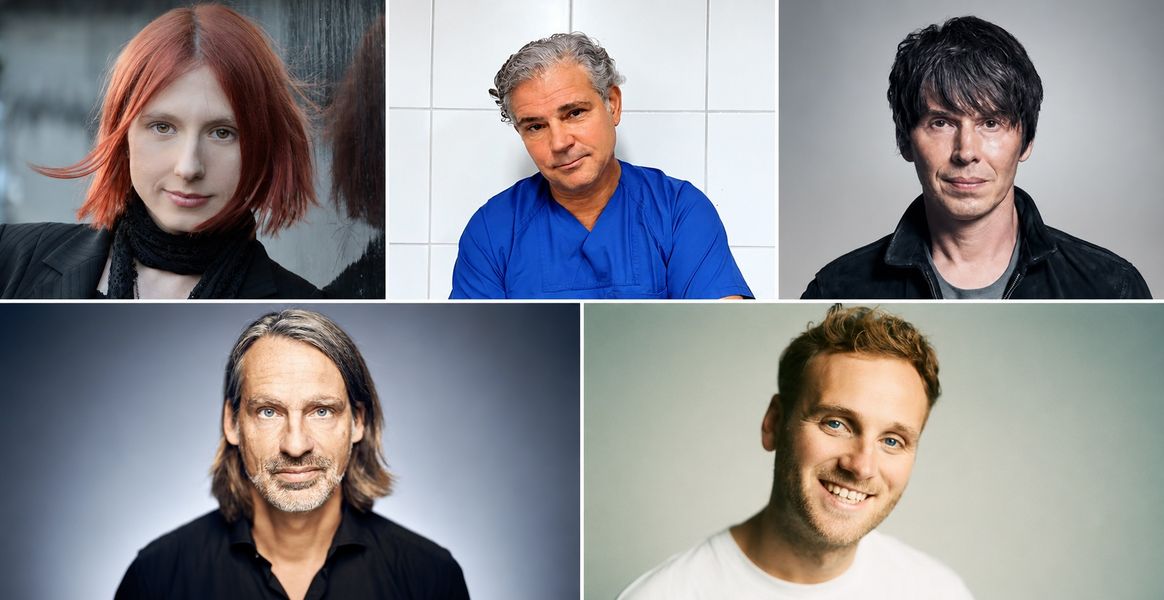
 Top: Lydia Benecke, Prof. Dr. Michael Tsokos, Brian Cox. Bottom: Prof. Dr. Richard David Precht, Dr. Leon Windscheid.
Philosophers, forensic scientists, psychologists, doctors, astrophysicists: A new generation of science communicators is filling concert halls instead of lecture halls. What do they all have in common? Complex knowledge that needs to be told in a captivating way, and an audience that wants more than just a Google search. We introduce five leading figures who will be making guest appearances in Switzerland over the coming months.
Over 300,000 people have seen psychologist and ZDF host Dr. Leon Windscheid at his sold-out shows. He’s coming to German-speaking Switzerland with his new program “Einfach sein” ( ). The question he poses is one almost everyone has thought about in their daily lives: Algorithms tell us which TV shows we’ll like and who we should date, but when asked what we really want, we shrug our shoulders. Psychologically grounded, with live experiments and genuine warmth. All in all, an evening that feels like neither a lecture nor a show, but rather a blend of both.
Richard David Precht is a philosopher, publicist, and author, and is considered one of the most popular intellectuals in the German-speaking world. He is an honorary professor of philosophy and aesthetics at the Hanns Eisler Academy of Music in Berlin, and his books are international bestsellers, translated into more than 40 languages. On the ZDF podcast “Lanz & Precht,” he discusses the socially and politically relevant issues of our time with Markus Lanz. The podcast has now been streamed over 100 million times on Spotify. Precht is thus far more than just an academic: he is one of the most prominent intellectual voices in the German-speaking world, both respected and polarizing at the same time.
A trained psychologist, psychopathologist, and forensic scientist, she investigates the psychological factors underlying criminal acts and violent crimes. Her research focuses on topics ranging from paraphilias to personality and trauma disorders, as well as superstitious beliefs, subcultures, and cults. She combines the latest findings in psychological research with thrillingly reconstructed criminal cases, demonstrating that sometimes only a paper-thin line separates us all from becoming criminals. Anyone who thought criminal psychology was dry science will be proven wrong: Benecke makes the depths of human nature tangible—without sensationalism, but with genuine expertise.
“The Phenomenon of Forensics” is the spectacular and long-awaited sequel to the smash hit “The Fascination of Forensic Medicine,” featuring new, gripping cases from Germany’s leading forensic pathologist. Prof. Dr. Michael Tsokos takes his audience back to his early days in forensic medicine, to international assignments such as his identification mission in Kosovo in 1999 for the International Criminal Tribunal in The Hague, or the identification of tsunami victims in Southeast Asia in 2004/2005. True crime from someone who’s right in the thick of it.
Following the global success of his program “Horizons,” which he presented to nearly half a million viewers, Professor Brian Cox returns with his new live show “Emergence.” The particle physicist from Manchester, who was involved in the CERN experiment at the Large Hadron Collider, brings cosmology to life in a sensory way. “Emergence” begins with Johannes Kepler on Prague’s Charles Bridge and his question of why snowflakes are always hexagonal. From there, Cox takes us all the way to the largest structures in the known universe.