

 FBM
FBM
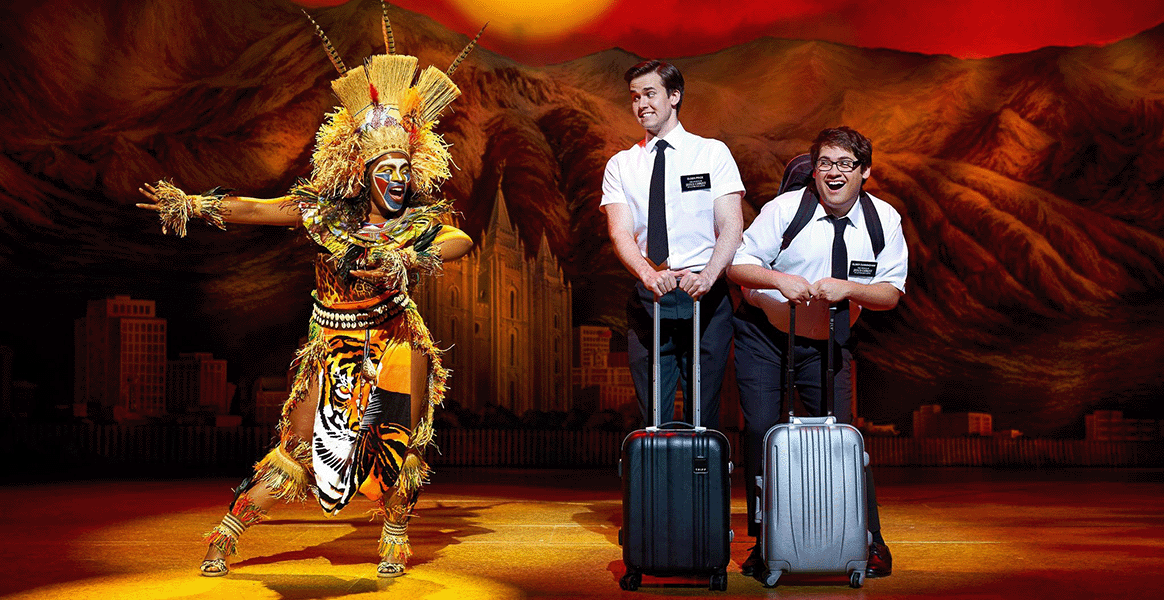
Anyone who expects musicals to be a soft-spoken, glitzy world will be surprised by "The Book of Mormon". Nothing is sacred in this stage show. It is brimming with biting irony, breaks taboos and is extremely crude in places. But above all it is funny.
They ring our bells too. Always in pairs and with an oversized name tag on their white short-sleeved shirts and black ties, they go from house to house, neat and tidy, asking: "Hello, may I tell you about a book that will change your life?"
They look like caricatures of insurance salesmen: Mormons who go out from Salt Lake City in America to all countries to spread their good news to the wider world - and to win and baptize new followers.
As all Mormons know with deepest conviction, God and Jesus visited a man named Joseph Smith in New York in 1830. He later dug up a pile of golden tablets of scripture and created the foundation of a new religion. The stronghold of the members of the "Church of Jesus Christ of Latter-day Saints", also known as the Mormons, was established in Salt Lake City.
We learn all this at the beginning of the show - but the musical is mainly about the story of two young missionaries: Elder Price and Elder Cunningham are to recruit new members in Africa. However, this turns out to be more difficult than expected, as the Africans have already been repeatedly educated about God by missionary Catholics, and yet nothing has changed in their evil lives. Which is why they are rather skeptical of anything religious - and they express this very bluntly in their song "Hasa Diga Eebowai". The song puts you in a good mood - but we'd better not write down exactly what this slogan means here.
Above all, the sonny boy Elder Price, who grew up in a sheltered environment, had imagined being a missionary in a completely different way; he would much rather have gone on a proselytizing tour in the ideal Disney and beach holiday world of Florida. Here in Africa, he is supposed to persuade people to be baptized as Mormons who live in a world of poverty, violence and hunger, tormented by disgusting diseases and tyrannical warlords who are not squeamish even with missionary boys spoiled by prosperity.
At some point, Elder Cunningham gets creative: he hasn't even read the Book of Mormon because it's so boring. That doesn't stop him from imaginatively rewriting it in his story, weaving in characters and events from "Star Trek", "Star Wars" and "Lord of the Rings" - that's how he can inspire the Africans. In the young, gullible Nabulungi, he finally finds the first person willing to be baptized. The singing scene with the two of them is a lovely counterpoint to the otherwise rather turbulent events on stage. It is often as blunt as it is outrageous, gag follows gag - things are called by name - and in a very vividly depicted horror hell dream, even Hitler and well-known fictional and real mass murderers and horrific figures indulge in their shameful activities.
The three talents responsible for the story, music and lyrics of the musical have a history: Trey Parker and Matt Stone are the creators of the cult TV animation series "South Park", which has been a hit in the USA for 22 seasons and has been revered by lovers of biting satire since 1999. Even there, the two creative minds have repeatedly attracted attention with religious satire. The third member of the team, Robert Lopez, has made a name for himself as co-creator of the Broadway musical "Avenue Q". Shortly after its world premiere at New York's Eugene O'Neill Theatre, "The Book of Mormon" was blessed with nine Tony Awards. After five years, the stage spectacle, which has now also enjoyed success in London, Melbourne and Sydney, is now coming to Switzerland - again in the original English version.
What explains the great success and the rave reviews? Why was there hardly any outrage or protests? Despite all the coarseness, "The Book of Mormon" is not flat - the irony of opposites drives the story forward. Its backbone is a skillfully conceived, thoroughly entertaining storyline following a classic pattern with well-placed characters who undergo an inner transformation in the course of the story - ultimately, the story, which at first glance seems blasphemous, could even be interpreted to mean that religion can be a great thing.
Even the real Mormons in the USA put a good face on the godless game - and advertise themselves and their holy book with full-page ads in the program of the Broadway production of the musical, whose version of the story is, according to their beliefs, "somewhat different" from the one in the musical.
Trailer of the London West End production.