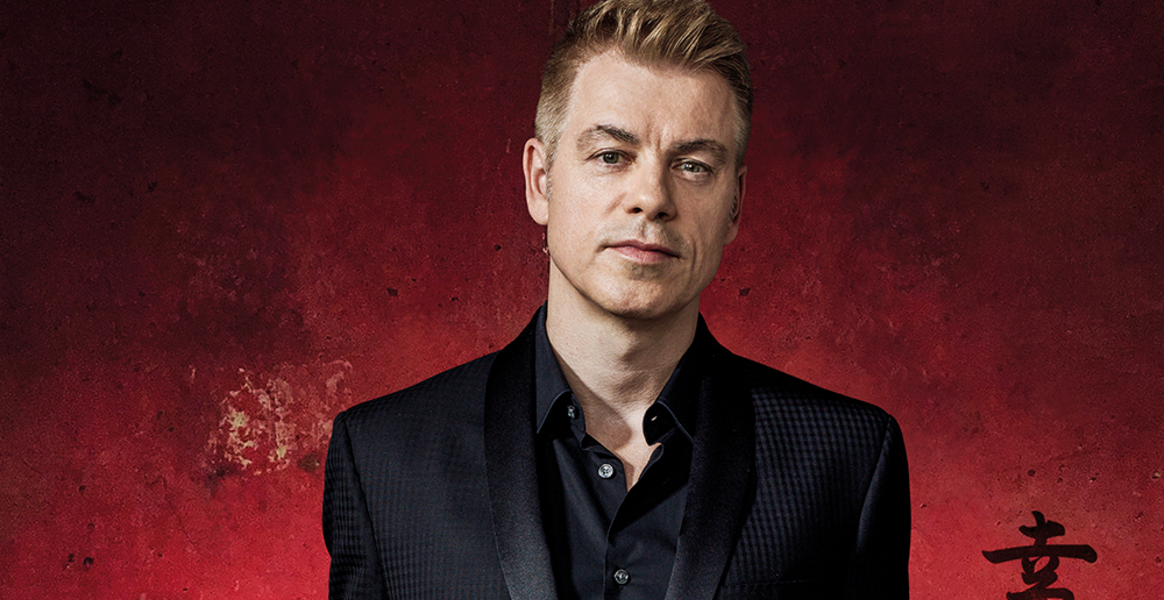
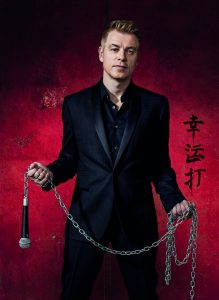
"The stupid and evil in the world doesn't need a caress, it needs a punchline right between the eyes," says Michael Mittermeier about his new program "Lucky Punch - die Todeswuchtel schlägt zurück", with which he is now coming to Switzerland. We spoke to the German comedy star - also about serious topics.
event.: Michael, how do you develop your punchlines?
Michael Mittermeier: I discover the topics in the media or experience something on the subway. I like to let the worlds collide. We live in a weird world: on the one hand, we are very nostalgic, but many people want to go back to tradition.
How do you remember the punchlines?
I always have a notebook with me (points to the book). I've never started writing a program as close to the beginning as I did this time. It was actually just before the first performance.
Do all your punchlines always work?
Sometimes there are punchlines that don't work. But I always say: nobody can get me off the stage without a laugh. But not everything can always work. Yesterday I recorded a TV special for ARD. It was a three-quarter hour performance with lots of songs from the past two years that have never been released on DVD before. I just played - and realized that there were also moments of silence. But all in all, people had fun.
You also perform in the USA - do you benefit from an "exotic bonus" there as a German?
Oh no, there is no exotic bonus at the Comedy Cellar in New York. In the USA there is only one criterion: funny or not funny. There is a kind of "comedy Darwinism", it's much tougher than in Germany or Switzerland. There are no intermediate criteria like there are here, such as "is it political?" or "does it have a social purpose?" - nobody cares about that there.
There are no intermediate criteria like we have here, such as "is it political?" or "does it make social sense?" - nobody cares about that there.
Are there other differences?
The punchlines are set differently. I'm a different guy on stage in the USA. I don't change, but I'm a German in America - and that's different than at home. So I'm there, and they've never seen a funny German before. It's logical that I play with the cliché! I do that in the USA, but also when I play in Lithuania or Switzerland, as I did recently.
Obviously the wind is blowing harder abroad in terms of comedy. Do we have to raise the bar here too?
It's incredibly easy to get to the top here, and you see comedians who make you think that you should have just let them perform before they go on the big stage. They become famous with two jokes and then play the same thing for ten years, destroying themselves in the process. But then there are others like the Swiss Hazel Brugger or the Swiss Alain Frei. I saw him for the first time years ago - and thought to myself: He has a good charisma. Alain Frei took up the challenge and played through hundreds of open mics. Now he's on stage in a completely different way - as a really good stand-up comedian. Hazel Brugger has also done everything right. It's not easy to switch from poetry slam to comedy. It takes the right attitude to perform and not go along with all the nonsense.
Can comedy really do anything? Even in these times of political correctness and the #metoo movement?
Yes of course, why not? Give me one reason why you shouldn't make a joke about something? How can a punchline or a joke be worse than the original? Satire always shines a spotlight on something absurd. The question is always: What is your approach, your intention? Why are you making the punchline? Do you want to hurt someone? Are you in a reactionary mood?
The question is always: What is your approach, your intention? Why are you making the punchline? Do you want to hurt someone? Are you more reactionary?
In a documentary I made about humor, I asked a Jewish comedian if I could make jokes about the Holocaust. He said: "Sure, it just has to be very funny." But there's always the approach. There is no topic that can't be done, why should we exclude a topic? Excluding a topic would be censorship. And it would be self-censorship. What's the point of that? You can't stop humor, it's like water and goes everywhere.
Being a comedian is obviously not always fun and easy.
Angelina Jolie said to me: "It's the hardest job!" It's the hardest art form, but also the fairest. When I met Bono from U2, he said that comedy is "pure art", the purest form of art. I always say: "Yes, Bono, what you do is pretty good too!".
Have you ever received death threats?
I don't know if you can call it a death threat, but there are insults like: "Hey, come to Dresden, we'll beat you up!" When we did that concert for the refugee aid workers back then, it was: "Get out of the country, you traitor to the people! I hope your daughter gets raped by refugees! - and then you'll know what it's like!"
Haven't you ever been afraid of that?
No, you just can't let something like that into your heart! I read all the comments, thousands of them, every single one, because I wanted to recognize the mechanism. But most of my colleagues don't read them - and that's a good thing. You have to get out after two days, otherwise your heart will turn black.
Now let's change the subject. It's always interesting when a comedian finds his own voice. When did you do that?
Well, "Zapped" was the discovery program. From 92, when the "Quatsch Comedy Club" started in Hamburg, it was woody, I tried out a lot. I did whole starship enterprise nights in Berlin. I wore a Spock outfit and just talked about Enterprise: That's when I realized I was at home. In advertising, MTV and pop culture. A lot of people from the comedy scene had advised me against it, but I said: "That's me - I know it better than anyone else!" "Zapped" was the program. I was completely myself then. I was mad at the TV, so I said to myself: "I'm going on stage now and I'm going to blow you all away." I said to my wife: "Gudrun, I'm going to sit down and write a program, I'm going to blow them away!"