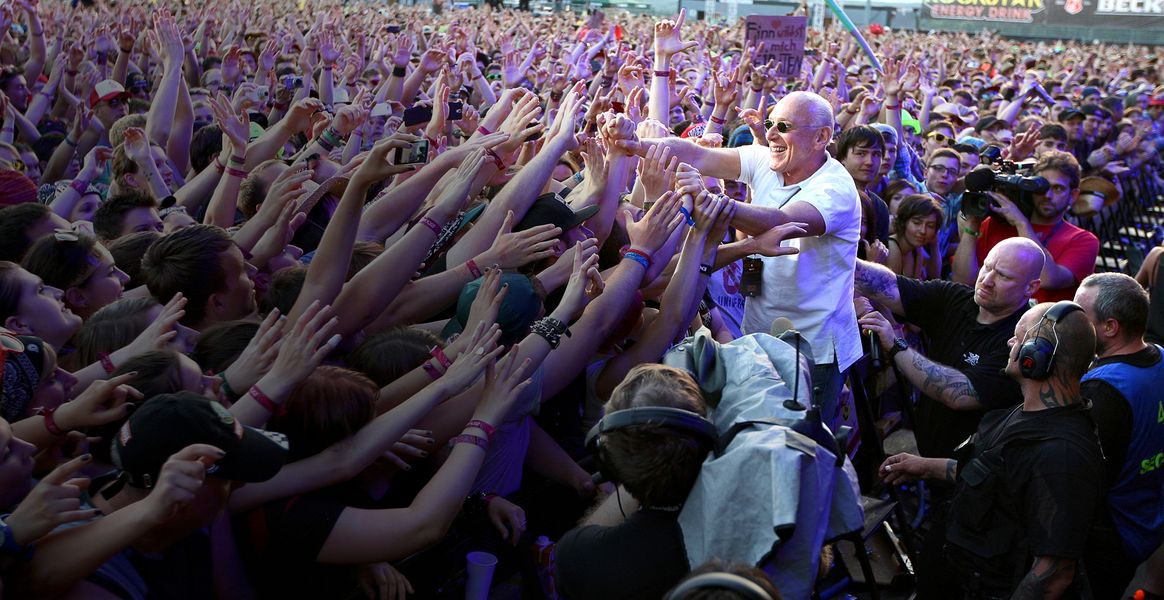
Marek Lieberberg (70) has been in the entertainment business since the late 1960s and is one of the world's most successful promoters. He has been working for the global giant Live Nation since the beginning of the year. We met him during a visit to Switzerland, where Live Nation has also been active for a year: most recently with concerts by Rihanna, Beyoncé and Coldplay - and soon with stars such as Depeche Mode and Sting.
Marek Lieberberg, you have been one of the most successful concert promoters for almost five decades. It's not an easy business. Tell us your secret!
Marek Lieberberg: A promoter has to balance empathy, experience and risk.
Was that easier in the past?
Today the situation is completely different. Back then there were no structures at all - now it's a global, international business, part of a complex network. On the other hand, for a young promoter or someone pushing into the music business, every address, every contact person is available. There is tremendous transparency. You can contact every manager directly and confront them directly with suggestions. In the past, you first had to build up personal relationships, find out who the decision-makers were and how to get in touch with them. Until finally, in London, you were tremblingly explaining to Who manager Peter Rudge why it wasn't a risk to go on tour with a young, ambitious music manager with no expertise.
... and how did you manage that in 1970?
With enthusiasm and persuasiveness. I think I suggested passion and groundedness at the same time, it was a mix of madness and a brilliant plan. I had the ability to convince artists out of nothing. The first successful concerts then became a record of achievement.
Were there any setbacks?
It was a long, arduous road with many ups and downs. Frank Sinatra was the first difficult test in the mid-seventies. We battled with media resentment and resistance to high, but not unjustified, ticket prices. The result: heavy losses that almost knocked us out. With the European tours of Leonard Cohen, Cat Stevens, Deep Purple and Pink Floyd, the situation suddenly changed in our favor. In my almost 48 years as a promoter, I have already experienced a few crises. But I am proud of the fact that it never came to a collapse, but developed into an unprecedented success story. Until 1986, I cooperated with my then business partner Marcel Avram - from whom I then parted ways for personal reasons - and then the quantum leap with the Marek Lieberberg concert agency, which operated worldwide for decades with outstanding results.
Could you still be successful in this business in the same way today?
We live in a completely different time today - pop music and the touring business that developed alongside it learned to walk in the late 60s / early 70s. It was learning by doing. And we acquired the know-how while we were creating the business. It used to be possible to gauge a group's drawing power fairly precisely by their record sales. Today, other yardsticks apply. Sales figures are only of limited importance. Popularity is measured by click figures and social media activity. Today, there are experts and specialists in all areas. Back then, I still did most of the work myself: I put up posters, sold tickets, set up equipment and drove my little VW in front of the band's truck to make sure they reached the next tour city.
Is the promoter business no longer interesting today?
There are niches for young promoters where you can still achieve a lot. Festivals and artists that move under the radar of the big conglomerates. Technology enables artists to distribute their music themselves. So there is a huge development field for creative and inspired people.
Are live promoters like you benefiting from falling record sales - because the stars now prefer to go on tour?
The record industry has not been lucky enough to be able to protect its business with barriers. Unfortunately, many opportunities were missed. There was disagreement and the familiar structures broke down. The barriers against free music transfer proved to be ineffective. Artists now need more alternatives.
So the stars have to earn their money on stage again - isn't that advantageous for them?
The artists like to call it "Escape from the Studio". But the live business can only be successful if it is based on actual popularity and demand. That's why there is a natural limit to live performances. It is important that creativity and integrity are not called into question. There are not many artists like Sting, for example, who constantly reinvent themselves.
Live Nation has been active in Switzerland since 2015. How do you assess the market opportunities?
Switzerland is a highly developed country with a very diverse culture, people who are interested in music and an excellent infrastructure. Good venues will soon be joined by other locations, such as the Samsung Hall in Dübendorf. This is exciting and increases the potential.
What are Live Nation's plans for Switzerland?
Until now, our outstanding international artists in Switzerland have been marketed by third parties. Now we are taking our destiny into our own hands. We are now marketing Live Nation stars such as U2, Depeche Mode, Kanye West, Sting, Madonna, One Republic and Coldplay ourselves. We are gradually building up our own business in a very transparent way.
Are you satisfied so far?
Yes, when Coldplay played twice at the Letzigrund in June, we were delighted with the 90,000 visitors. The results for Beyoncé and Rihanna were also impressive. We operate in Switzerland with a small but extremely competent unit under the leadership of Ralph Schuler, which is already extremely successful.
Which artists will you be bringing to Switzerland soon?
Depeche Mode are coming to the Letzigrund. We are also presenting attractive artists such as System Of A Down, Sting and Patricia Kaas. So far, we have largely concentrated on big names, but as in Germany and Austria, we naturally focus on promoting talent.
Do you also see it as your duty to promote young talent?
Developing young artists is in our DNA. That's how we win the future. I fondly remember the first U2 concert in the 1980s, when only 80 fans came to the Hamburg Fabrik. A few years later, the band sold out stadiums.
What is your favorite music to listen to? Who is your personal favorite star?
I know that you can only do this business if you create an intellectual balance. Literature, theater, classical music, but also sport - I swim, jog and play tennis. It's the only way to lead a life in the fast lane.
You turned 70 in May - are you thinking of retiring?
I think so, but in practice the opposite is the case! Today's demands have increased enormously - this permanent availability, the fragmentation of news via e-mail. It's a curse of the times that people no longer learn to think in context.
Do you use social media?
For business, of course. But privately, my motto is that you can't find me on Facebook or follow me on Twitter. Self-promotion is the raison d'etre of the industry, but I don't have to do that anymore.
About the person
Marek Lieberberg (born 1946 in Frankfurt am Main) was a musician on stage at a young age: as the singer in the beat band Rangers, he performed at the legendary Star Club in Hamburg and as the opening act for Fats Domino.
After dropping out of his sociology studies, he became a journalist at the AP agency, where he also wrote press releases and program booklets, thus becoming more and more involved in the emerging promoter scene.
In 1970, he founded the Mama Concerts agency with Marcel Avram and organized concerts by The Who, Deep Purple and Pink Floyd. In 1986, he separated from Avram and organized tours for numerous bands and stars with his company MLK (Marek Lieberberg Konzertagentur): from Aerosmith to Bruce Springsteen, U2, Dire Straits, Céline Dion and many more.
Marek Lieberberg later sells his company to CTS Eventim. He has been CEO of Live Nation Germany since the beginning of 2016. Live Nation, the world's largest live entertainment company (7.2 billion dollars in revenue in 2015, over 23,000 shows annually), has exclusive contracts with superstars such as U2, Sting, Madonna, Coldplay and Depeche Mode. Live Nation has also been active in Switzerland since 2015.